• Skip to main content
LiveCreativeStudioNEW_Final
  • Services
    • Marketing & Branding
      • Portfolio
      • Creatives
      • Download-Brand Identity Guide
      • Pro Tips
    • Sustainable Business Services
      • Sustainable Business Principles & Frameworks
      • Climate Positive Business Guide
      • Download- Scale Your Sustainable Biz Guide
  • Marketplace
    • Durango Sustainable Business Guide
  • Carbon Crunch
    • BringIt!
  • Blogs
    • Sustainability
    • Sustainable Innovation
    • Sustainable Lifestyle
  • Get Real eNews
  • 0 items

Blog

Good Design Doesn’t Just Look Unique and Function Well; it Follows the Laws of Nature

October 25, 2021 By admin

circular-packaging

Guest Blog by Anaïs Passera of Grown.Bio with an update by Claire Attkisson

Carbon is not the problem. Carbon is not the enemy. Carbon is a key building block of all life. It belongs. It belongs in our soil. It belongs in our bodies. It does NOT belong in such huge quantities in our atmosphere and air. This may sound insane at first. You see, sustainability has a narrative problem. The sustainability community focuses on the “moral” narrative too much and at our peril: “do good”; “be less bad” ;“do the right thing”; “zero carbon”; “net zero”….It’s easy to get caught up in this language. I do too. We see climate change as a moral cause because we are finally seeing the true cost of designing and powering an economy outside of the laws of nature: our very own human existence is hanging in the balance. It’s not “save the polar bears” time. It’s “save the humans” time. Now we’re awake. Well, at least some of us are.  

Why I take issue with the moral sustainability narrative is that it makes some of us “good” and others “bad”. This division will never lead to global change and success. Instead, McDonough (founder of cradle-to-cradle design) and Benyus (founder of biomimicry) argue that nature has already figured out how billions of species can thrive together over billions of years.

So how does nature do it? Nature’s laws of life are:

1. There is no such thing as waste, just biodegradability: death=life; waste=food;

2. Energy comes from the sun;

3. Oxygen and carbon are the bases of all life;

4. Nature competes, but mainly cooperates through symbiotic relationships. We didn’t set out to design our global economy to harm people and destroy the planet. Now we know.

Now we know carbon belongs in the Earth and in us. The sustainability narrative I’m promoting is about sharing what makes “good design”. Good design isn’t just how cool something looks or functions (yes, this is very important), but how it incorporates the laws of nature. Good design fosters life.

Grown.Bio Product Packaging

Grown.Bio is a company designing packaging and products that do just that—naturally. Grown.Bio grows material from mycelium and wast-streams, creating a fully biodegradable material that also captures and stores carbon.

Grown.Bio support the transition to a circular economy by creating a biodegradable product through a production process that is CO2 negative. It is the ONLY material, together with algae, that is capable of acting as a carbon sink.

Grown.Bio Planter

How is this possible? Mycelium is a living organism that captures CO2 from the atmosphere during its growth process and stores it in the material. How wonderful is that!

Mycelium is the root system of mushrooms. This allows Grown.Bio to literally grow products such as packaging, insulation panels or interior design objects and furniture. Mycelium has a binding effect and ensures that the grown network of fungal threads glues a substrate together.

Grown.Bio Packaging

Any product shape and size can be ‘grown’ in a mold. The process takes about 5 days, after which the product is removed from the mold to be dried in an oven. This stops the growth process of the mycelium and therefore ensures a sturdy material!

Products made with Mycelium are a sustainable alternative to plastic-based materials such as polystyrene foam. Due to its properties, it can perfectly serve as protective packaging or insulating panels.

Due to its lightweight, velvet touch texture, many companies have already showed interest in changing the way they design and use packaging. A few examples are MyBacs and Haeckels.

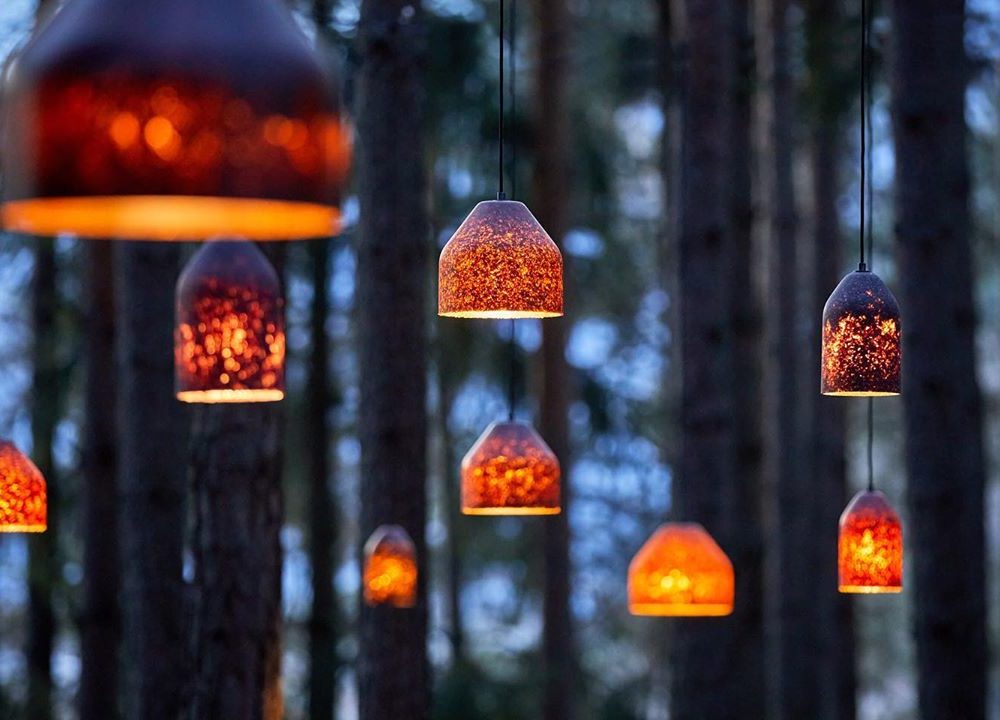
Grown.Bio Lighting

Why is this innovation a circular solution? Since Mycelium packaging is a biological nutrient free of toxins and is 100% biodegradable, its end of life is either as an object of interest in your home as a newspaper holder, a candle holder, a pot for a plant, and more. Mycelium packaging also makes for a healthy compost for your home garden: when broken into small pieces, the parts decompose within a few months.

_______________________________

About Grown.Bio: Our mission is to make a positive impact by changing the way people and companies see and use packaging. These days, it is essential to work together with nature; we grow living organisms into shapes that are useful and then biodegradable. It is the story of circular materials that makes our product as beautiful as it is!

www.grown.bio

___________________________

Live-creative-studio=logo

If you liked this and want more, join us by subscribing to our weekly eNews Get Real— an Innovation for Good mash up of marketing and lifestyle tips and positive news about cool sustainable brands and innovators changing business for good. Get Real inspires and offers practical pro-tips to help individuals and businesses increase their positive impact.

Live Creative Studio is a sustainable business, marketing, and shopping hub. Live Creative offers strategic creative for purpose brands; strategic sustainability for any business; and a curated sustainable marketplace for everyone to shop their values every day.

Filed Under: Blog, Innovation Tagged With: carbon sequestration, carbon sink, cirular design, good design, mycelium packaging, nature-inspired design, sustainable packaging

Join the Sustainable Food Revolution: Waste Not, Want Not

October 9, 2021 By Claire Attkisson

food-waste-scraps-food-innovation-blog
sustainable-food-innovations-blog-family-meal
Farm Fresh Family Meal

How can we re-design a food system that supports farmers and the land, is truly healthy, and results in a life-supporting local and global economy poised to feed billions?

We’re amazed at what we found out researching these questions. Human innovation, ingenuity, and creativity seem to thrive when times are tough, and we finally recognize natures design constraints. Our blog this month shares cool stories of revolutionary food innovations sprouting up across the globe that are beginning to define a sustainable food paradigm by addressing world hunger, climate change, and turn food deserts into abundant nutrient oasis’…it’s happening, people!

Growing Food in the COVID Context

We humans invented Democracy and we went to the moon—testaments to human potential; yet in crisis it turns out that our survival depends, not on self driving cars or appliances that talk back to us in English and Finnish, but rather on the same basic building blocks that all animals require: clean food and water and washing our hands (that is to say, hygiene). The call is out to return there, to remember who and what we are; to pause (a different kind of action) and look back to what we’ve created and manufactured for growth and progress, and use our new innovative thinking, to get the basics—food, drink, exercise—right. How we do this, our purpose, is the “secret ingredient” or the magic, to make surviving/sustaining our compelling collective cause and lifelong endeavor.

Self-care, at its most generous, is the conversation between friends, companies, school systems, countries. Taking care of each other and our world. Sustainability as the “new normal” can redefine definitions of progress and inspire tremendous design and creative innovation.  Small and big businesses alike know this more acutely now, as ESG investing is out performing standard investing during the crisis. Caring about people and the planet is the new competitive advantage for business. “We, the people”, care what happens to our world, our home. COVID points to the fact that human encroachment on wild land is bringing human contact ever closer to new life-threatening diseases. For growing numbers of people, a spot-light is shining on our economic and business as usual model. Our global economy connects us all. The time is now to design a life-sustaining economy. This is no longer abstract. COVID makes it real.

farmers-market-sustainable-innovation-food-blof
Farmers Market Bounty

Inspiring Food Innovation Companies You Should Know and Support

There are five trends emerging in restaurants that we will once again leave our homes to dine in—likely, with greater elbow room. Pockets of sustainability-inspired venues have been popping up across our country and others; now the movement is inspired, bringing whole new tastes and smells, and acres and networks that create purpose and repurpose to what and how we eat food. There is a tacit understanding and trust between patron and establishment on the terms of their relationship. “Infusion” is not in the tiring details of self-conscious waiter’s recitations (thyme and whats-its in meat, pistachios in chocolate chip ice cream.) It is trust that the triple bottom line (people, planet, profit) is infused in the fabric of the menus and how the business operates.

The meals we make and bring to our table require the same standards. We cringe at what we perceive as the inhumane acts of taking fins from sharks and throwing the bodies back into the ocean. We are care about where our food comes from and where it goes.

Our nomadic ancestors chased their prey into canyons and slaughtered them. It was their only way and they used every bit of the animals they caught. We are moving away from the mass slaughter idea and embracing the habit of using the whole animal once again. Restaurants and chefs are often personally connected to local butchers, farms, and fish nurseries.

London-Meat-Free-Buther-Food-innovation-blog
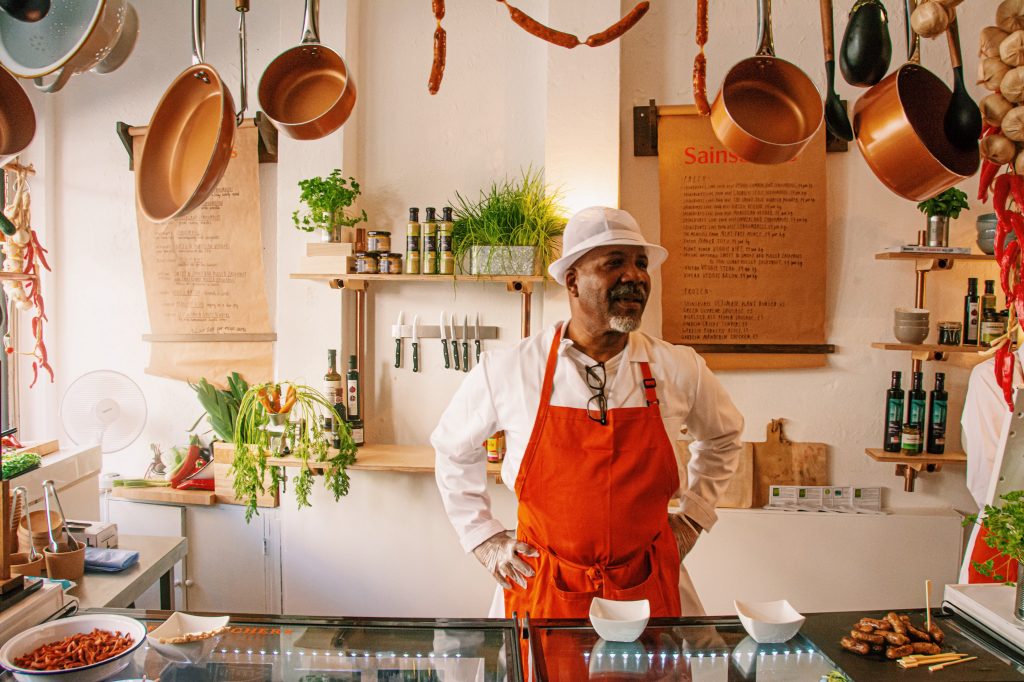
London’s First Meat Free Butcher Shop

Then there’s the “Beyond Meat” movement. London just opened its first “Meat Free Butcher Shop“. An in-store butcher, trained in plant-based cooking, will do live demonstrations of meat-free recipes and give tips to customers on how to create mouth-watering vegetarian and vegan dishes at home. Customers will be able to choose from 20 animal-free products, including the likes of BBQ-pulled jackfruit, chorizo-style Shroomdogs, meatless bacon, veggie ribz and Moroccan vegbabs. All purchases will be weighed and wrapped just like in a traditional butchery.

Spoiler Alert

Composting our food waste is a successful end of life solution for farms and individuals, however, for grocery stores this is simply not done. What if we knew when food was going to spoil on grocery store shelves before it spoils?  Spoiler Alert is a new company doing just that—using data to manage waste and unsold inventory so effectively that they are helping their customers feed the most needy as a result. “Since the start of our pilot program with Spoiler Alert, we were able to donate over 1.5 million meals over the last year” said Laura McCord, Executive Director of Sustainability and Corporate Responsibility at KeHE, a national food distributor.

ReFED 

ReFED is another food innovation company that has created a road map of 27 different ways to reduce food waste, while creating new jobs. Imagine that—no more Jobs vs. the environment grid lock! The organization has launched the ReFED COVID-19 Food Waste Solutions Fund to quickly deliver vital funding to organizations that can rapidly scale food waste reduction and couple them with hunger-relief organizations.

stockton-CA-farm-to-family-program-sustainable-food-innovation-blog
Stockton, CA Farm-To-Family Program

Meanwhile, in California, the #1 agricultural producer in the US, amidst the COVID pandemic Governor Gavin Newsom recently announced an expansion of the state’s “Farm to Family” program, that will aim to address the disconnect between the state’s farmers — who, since the onset of the pandemic, are experiencing a 50 percent drop in demand for their mostly perishable food — and food banks, many of which are scrambling to meet skyrocketing demand from families in need.

The initiative will enable food-insecure people across the state to receive roughly 20 million pounds of fresh, locally produced food per month. Participants will receive fresh food boxes — each of which feeds a family for three to four days.

Upcycled Food —What?

“Upcycled Food” is not as bad as it sounds (we’re not talking mother birds regurgitating into their chick’s hungry mouths!). It’s a fast growing fledgling industry, which creates new, valuable food products out of the overlooked nutrients falling through the cracks in our food system. Imagine: vegetable stems turned into chips and leftover juice pulp transformed into granola to surplus bread (reborn as beer!). This spring, food waste prevention nonprofit, ReFed, released a census that said 11 such food companies existed in 2011. In 2017, there are 64 and counting. An amazing 400-and-growing upcycled products are currently on the market (according to the Upcycled Food Association—yep, there is one!)

upcycled-food-brands-food-innovation-blog
Upcycled Food Brands

An Upcycled Economy is Climate Positive

Last year, Future Market Insights produced a report in which it estimated that the value of the upcycled food economy was more than $46 billion, and predicted a five percent compound annual growth rate over the next decade. This is real money!

According to scientific and policy experts, including the Intergovernmental Panel on Climate Change and Project Drawdown, the world leaders on ranking climate change solutions, rank reducing food waste as the number one solution to the climate crisis.

According to the Upcycled Food Association upcycled food businesses are currently preventing at least eight million pounds of food waste per year, equivalent to millions of pounds of CO2 emissions prevented, and millions of gallons of water saved. 

As the Great Depression era taught my grandparents to save and reuse everything, this same ethic is being recognized again in the era of COVID as a key driver of a new life supporting upcycled food economy.

Business innovation is leading the way, are you ready to get on a much more fun and creative merry-go-round and reinvent business as a force for good? Join us.

food-waste-scraps-food-innovation-blog
Waste Equals Food

_____________________________________________________________________

Live-creative-studio=logo

If you liked this and want more, join us by subscribing to our weekly eNews Get Real— an Innovation for Good mash up of marketing and lifestyle tips and positive news about cool sustainable brands and innovators changing business for good. Get Real inspires and offers practical pro-tips to help individuals and businesses increase their positive impact.

Live Creative Studio is a sustainable business, marketing, and shopping hub. Live Creative offers strategic creative for purpose brands; strategic sustainability for any business; and a curated sustainable marketplace for everyone to shop their values every day.

Filed Under: Blog, Innovation Tagged With: Biomimicry, food waste, purpose brands, sustainable business, sustainable company, sustainable food company, sustainable innovation, upcycled food

Free Downloadable Tech Backgrounds for October 2021

September 30, 2021 By Maya Bradshaw

Fall is here, and so are our October desktop backgrounds! We hope you find a little joy in this month’s selection, featuring moody colors, playful graphics, and intricate designs. Happy Autumn to our wonderful Live Creative community!


Download October Background

Download Music Background

Download Velvet Wallpaper Background

Download Organizer Background


Live Creative is a sustainable business, marketing, and shopping hub. Our Creative Studio offers authentic marketing, branding, and sustainable business expertise to ethical, sustainable, and purpose brands. And Sustainable Business Team offers sustainability strategy and goals setting as well as sustainable packaging services. And, our Lifestyle Team curates our global Sustainable Marketplace, the Durango Sustainable Biz Guide, and Get Real—our inspiring Innovation for Good weekly newsletter. Follow us on Insta: @livecreativestudios, like us on Facebook: Live Creative Studio and join our FB Group: Sustainable Business Idea Exchange.

Filed Under: Blog, Lifestyle Tagged With: downloads, free desktop calendar download, free desktop download, inspiring quotes desktop download

Beyond Net Zero: Your Guide to Scaling a Climate Positive Business.

September 22, 2021 By Claire Attkisson

climate-posirtive-business-guide-image
Timber_Age_Systems_CLT_Builder
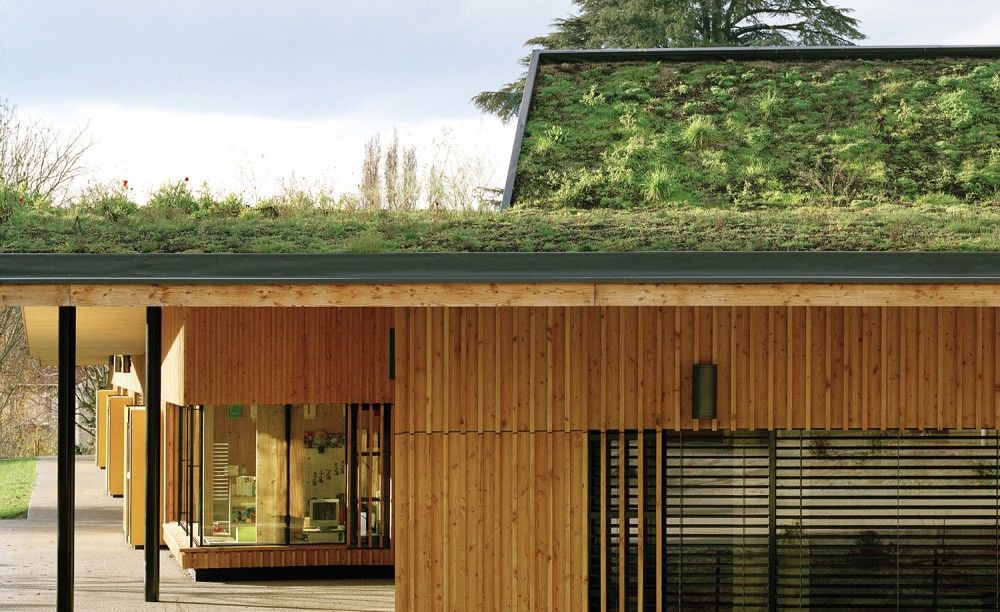
Carbon Sequestering roof and cross laminated timber panels

It’s time for all businesses to do their part to change business for good and create a climate positive plan of action. Small business to large corporations all need to play a role in decarbonization (i.e. eliminating Green House Gases (GHG’s) and the use of fossil fuels in their operations, ditto for their suppliers, in shipping, packaging, and product material inputs) over the next 10+ years to thwart catastrophic climate change.

The good news is that we have solutions. Business solutions such as, carbon offsets (i.e. tree planting; deforestation investing, etc. solar farms); redesigning fossil fuels out of our product materials, supply chains and operations; converting to renewable energy to power your office and/or facility, and…The possibilities are many and the key to success is setting goals and a system for measuring them.

As the axiom goes: “What gets measured, gets done.”

cork-element-sustainable-lifestyle
Cork Element Carbon Sequestering Forest Cultivation

6 Steps to Net Zero

  • Step one: Organizational leaders (i.e. the owner, entrepreneur, c-suite, CEO + board) must lead the decarbonization and/or net zero charge by setting a clear and meaningful vision. One of the first challenges businesses face in sustainability efforts is articulating a long-term vision with realistic, short- and mid-term goals for action. Without leadership driving the process, most sustainability programs stall and fail.

  • Step two: Start with the low hanging fruit. Set a short and mid-term emission reduction of Green House Gas (GHG) target through the Science-Based Targets initiative (SBTi), which evaluates corporate goals goals for alignment with what science shows us is required to keep warming below 1.5°C per the Paris Agreement. Science Based Targets are also a great guide for start-ups and small businesses.

  • Step three: Most companies start their sustainability journey addressing Scope 1 and 2 GHG emissions, which include direct emissions and those from purchased energy for companies’ own use. However, to truly achieve net zero requires a holistic view of the entire value chain. This means companies should incorporate Scope 3 emissions, which are indirect emissions from upstream and downstream activities, like employee commutes, supplier emissions and end-of-life (i.e. so called waste) product ingredients (time to phase out petroleum and plastics) processing.

live-creative-studio-sustainable-innovation-blog
Our oceans can no longer absorb carbon without becoming too acidic
  • Step four: Establish your baseline and set realistic incremental goals. To begin, companies need to know where they are now and develop a thorough understanding of their environmental footprint, including scope 1,2 and 3 emissions, to help quantify and identify areas of improvement throughout the entire value chain.

  • Step five: Consider GHG offsets; redesigning your product to sequester carbon; or installing solar or wind power for your operations and the companies in your product value chain; or investing in regenerative farming and deforestation projects that help to sequester carbon. The solutions are here it’s really a matter of leadership taking action.

  • Step 6: Integrate sustainability into daily business operations. Defining how your unique business can become climate positive is just the beginning. It’s critical to translate sustainability goals into realistic action plan. Leadership should communicate the mission, vision and strategies clearly and ensure that sustainability practices are implemented into day-to-day operations and all employees are held accountable to specific decarbonization goals that they are responsible for in their job duties and evaluations.

Solar Power

The Benefits of Action

The late Ray C. Anderson, founder of Interface Carpet—one of the most sustainable companies on earth once asked:

“What is the business case for ending life on earth?”

An important question, but equally important is the business community’s response. We simply cannot continue business as usual if we hope to have a “climate fit for life” on earth.

The benefits of a climate positive plan for your business include:

  • competitive advantage
  • a values based workplace
  • product innovation
  • purpose-driven
  • a legacy impact
  • business longevity by supporting life on earth

Carbon in the Air Can Be Turned into A Business Opportunity

Resources

  • Set GHG Targets with the help of the Science Based Targets Initiative: https://sciencebasedtargets.org/

  • Offset your GHG emissions locally or internationally with: Four Corners Office of Energy Efficiency Carbon Offset Program: https://4cornersoffset.org/how-it-works/ or The Gold Standard: https://www.goldstandard.org/

  • Offset your plastic use with Plastics for Change: https://www.plasticsforchange.org/blog/what-is-plastic-offsetting

  • Host your website with a company that invests in renewable energy: https://www.greengeeks.com/

  • Search the web with an engine that invests in reforestation: https://www.ecosia.org/

  • Redesign waste and fossil fuels out of your products with Cradle-To-Cradle Safe and Circular Design: https://www.c2ccertified.org/education/safe-circular-material-choices

Download this Guide here:

Download: Becoming a Climate Positive Business Guide

_______________________

If you liked this and want more, join us by subscribing to our weekly eNews Get Real— an Innovation for Good mash up of marketing and lifestyle tips and positive news about cool sustainable brands and innovators changing business for good. Get Real inspires and offers practical pro-tips to help individuals and businesses increase their positive impact.

Live Creative Studio is a sustainable business, marketing, and shopping hub. Live Creative offers strategic creative for purpose brands; strategic sustainability for any business; and a curated sustainable marketplace for everyone to shop their values every day.
Live_creative_studio_logo_design_purpose_brand_agency
https://www.livecreativestudio.com

Filed Under: Blog, Innovation Tagged With: climate positive business, how to reduce GHG emissions, local sustainable business, net zero business, net zero business guide, sustainable business, sustainable business guide, sustainable business tools, what is a sustainable business?

Redesigning Our World Now: Optimism, Biomimicry, and Design

September 20, 2021 By Claire Attkisson

sustainable-design
Peacock_biomimicry_live_creative_studio_blog

The truth is, much of the world’s social and environmental problems can be solved by literally redesigning our world. As a marketing and creative agency in Durango, Colorado, with global impact, Live Creative Studio works with both entrepreneurs and established companies to innovate through purpose-driven branding and marketing. Some call it eco-marketing or sustainable marketing, while others call it marketing for conscious, green, or B Corporations. We call it purpose-driven marketing. We design for impact. We design to change the world no matter how you define your company.

To explore this idea of re-designing our world, I teamed up with an optimistic friend, writer/editor, Elizabeth Arlen. We will write a blog a month to bring to light all that is possible through inspiring design and new paradigms of thinking. This first blog focuses on the “earth shot” that is deeply needed in order to transform the way we make everyday things and why that even matters. We look to a new concept and tool called Biomimicry developed by scientist and scholar, Janine Benyus. She points out that Nature’s genius design principles have sustained life for nearly 4 million years, and maybe we should stop disassociating and become teachable to natural ways to drive our world’s product innovations and our new economy.

Capitalism is not the great evil; the toxic ingredients we use to make our products and short term greed need a serious reality check, now that we have the knowledge and technology to redesign them. There are no coincidences: just as we need it, we have opened up a vast new frontier. The truth is we haven’t veered off the path of progress, as so many lament; the path of progress has led us right here. Life is messy. Our learning curves are not quick and they include accidents and ugliness. So it has always been. We didn’t invent penicillin, child labor laws, seatbelts and CPR just in case a tragedy should ever happen. The tragedies happened first. We are right where we are supposed to be. The Penicillin of today is a new business and economic paradigm built on sustainable product design that upholds the natural laws of what is conducive to life.

A brief historical context: How did we get here?

The truth is, we are optimists, We the People, are. Yes, there is an American stamp on this phrase but, truthfully, all over the globe, for thousands of years, groups of any amount above an one, have been referring to themselves with equal self-possession and toward a higher purpose (there may have been a plan to go bowling but the research on that is thin).

With optimism and practical shoes, Colonists, set sail across the Atlantic in the 1700s to, oh, you know, create a new Country. It was not their second one. This was their singular shot, fueled by desperation and an optimistic faith in their cause: to create conditions conducive to Life, Liberty and the Pursuit of Happiness. In India, in 1932, Gandi’s 7-day fast was as loud as any revolution; surrounded by fear and hate, his faith and optimism in the best of humanity, committed him to the same cause: to create conditions conducive to life, and at the risk of his own (hence, his optimism). The Dali Lama, of a Chinese oppressed Tibet, stands for a cause when he travels the globe as someone who is real and light and wrote the book, “We are Responsible for our own happiness.” We are. We must be our own heroes. We must gather our optimism to meet the needs of life.

In the West, we create movies that echo the inspiration of, “We will overcome,” and “I have a dream.  Classics hang on or are redone, like, ‘Annie,’ ‘The Wizard of Oz,’ ‘Rocky’ and Zeffereli’s tweaking of Shakespeare’s ‘Romeo and Juliet’–the blueprint for every love song and story ever told– because we really do believe them: The sun will come up tomorrow; there is no place like home; the best of our humanity will empower us to rise up in triumph (yes, Romeo and Juliet, are actually too dead for that; but for 47 hours those two kids shared a divine and optimistic love that raised them above all else, and when Prince Eschalus declared “All are pun-ish-shed!”, the Montagues and Capulets fell to their knees to process their first phase of grief and flawed humanity). The unbound optimism of love was the victor.

Today’s Marvel heroes and Tom Cruise’s still very fast Ethan Hunt, believe there’s no place like home and run down Dubai buildings or take to the skies with hammer, iron, sticky string, breastplates, and good looks, in order to save it: earth. And, people, do we identify with the screaming civilians scampering in fear into an upended Starbuck’s and H& M? Anyone? Of course we don’t. Sure, a lot of us think we want someone else to swoop in and save us; but the truth is, in our hearts, we identify with the optimism and bravery of our heroes—we have it inside us to be one, on the saving side.

What? Yes, when Robert Downey Jr., looked at us and announced, “I am Iron Man,” we thought, ‘He’s dreamy” (well, to some, it’s in the report);  what we actually thought is,  ‘I am Iron-man,’  ‘I believe, too.’ Yes, when our heroes’ eyes deepen and shimmer into their souls, we, the audience, feel the tug on the hope and heart of our own humanity, and want to jump up and ‘Just do it.”

Outside of the theater, today is fast and distracting. It’s hard to find a culture around the globe that isn’t completely online and virtually doing everything. We have our smartest phones and our noses in them, while we don our serious suits or Lulu lemon leggings; with our free hand holding a blue print or protein bar or another little hand; we fight the good fight, doing our best to be the best with an ambition to be successful in our belonging.  But belong to what? Ourselves, with nature as the backdrop? Stand on your heads if you have to, because our perspective is more than off. It is not real: We belong to nature and need it, just like the rest of earth’s creatures, with our own Kingdom, Phylum, Class, Order, Family Genus, Species.

Nature is not a place that exists only when we are on vacation. We all feel the pull it has on us, don’t we? How we gaze at sunsets and sunrises and the stars and love the feel of the beach under our feet, the crunch of leaves, the smell of the rain; we ride our stationary bikes looking at a virtual trail on our monitor; we even go to bed listening to the electronic sound of the wind, the wolves or the Whales (and not just to hear Robert Redford). We are part of nature. It is within us and our home.

But what of the optimists in these climate changing times?

Optimists, step forward. Optimists are our valuable dreamers equipped with hope and knowledge; they are the people who are quiet and not apocalyptic about our future because they are too busy working in it. Inspired by their optimistic vision, they have seen that Nature’s diversity is the new paradigm in which to work and create. There is no place like home.

Our heroic optimists are in action and we can choose their side over the stagnation of a small vision of division among and between the races, classes, genders, parties, etc. ‘Just Do it.’ It’s Nike’s brilliance to tap into our inner heroism; to know we can’t think ourselves into right action or talk ourselves into right thinking: Action is where we must live. Action is life.

Janine Benyus, with her calm humility and deep wisdom, is one such optimist: “Life creates conditions that are conducive to life.” This simple and profound sentence summarizes her perfect understanding of the success of Nature. Benyus is an example of our natural wiring; whether it is from hope or optimism or something primal, we, just like the rest of earth’s inhabitants, want to create conditions conducive to life. She is not panicking; she is open and smiling and in action, spreading the word everywhere, including on Youtube and the ‘Today’ show. She knows something—even the excited “Today’ reporter could feel it tromping breathless and bubbly behind her in the woods.

What Benyus knows is the test of time of nature’s design, which she calls Biomimicry.  Biomimicry “is an innovation that seeks sustainable solutions to human challenges by emulating nature’s time-tested patterns and strategies.” 

All or not punished, after all! We know a way out of this mess. We have not veered from the path of progress, remember? “The only thing to fear is fear itself.”  Remember? Now, is the time to regroup, and reconsider what we strive for.  We need to reframe the design of all things to ensure the existence of our resources and all of our children’s sunsets, and their children’s. The sun will, indeed, come up tomorrow.

Does someone have a blow horn? Everyone should know that Biomimicry is a game-changing tool.

We need to communicate loudly or through millions of “beats” around the world that the sky is not falling. We have solutions; the absolute possibility of a livable future. This is where true grit turns to face the challenge; this is the time when great leaders inspire and say with faith and hope, “I have a dream!” “Ask not what your country can do for you but what you can do for your country.” Those optimistic leaders and the quieter one like Janine Benyus, believe in us.

Do we believe in ourselves? You mean right now? Not so much. We are certainly moved by media to constantly point to what is not working, instead of inspiring what is possible. We traumatize ourselves with HBO specials showing brilliant scenes of oceans and sunsets that suddenly assault us with bulldozers raping the Rain Forest or Polar bears floating on a foot-long slab of ice. We do not bring forth our power by pointing to the mistakes or evil among Us. We ‘just do’ absolutely nothing with guilt or blame or hate to distract and paralyze us.

We consumers are weighted down with this rumor that the answer to our problems is recycling. It helps, but the consumer cannot bear the brunt of solving our environmental problems; nor is it a real solution. No wonder we feel powerless and overwhelmed. No wonder we suffer in an unnecessary atmosphere of doom and gloom which so many of us feel today.

Raise your chins, and get radical with the optimism within you. Negativity and gloom are so last year. Believe, because nature is our solution.  Nature doesn’t have a waste problem. It knows what it’s doing. We, our young little species, do. But we are teachable.  So what can we learn from nature?

What does Biomimicry have to do with re-designing our world?

tree_of_life_pic

Designers, this is our cue. We need to begin at the beginning, with people who design products, not just use them. How we make every day things, as well as luxury things, is a radical act. The very product ingredients, the chemistry, and their end of life, are all critical design stages from which nature can inspire us and bring about new ways of manufacturing that are conducive to life.

“Form follows function” is emblazoned in the hearts and minds of all young design students, as well as, seasoned practitioners. If we follow this wisdom, then understanding the “function” of an object is a critical first step. What purpose does the object have? Is the object/product conducive to life?

Biomimicry can help us answer these questions. It is not only a new model for design and innovation, it’s a a path to re-designing our world as we know it. Biomimicry (learn this term!) challenges designers to be at the forefront of creating things that we use and dispose of every day, as if our nature mattered—and it does. Designers love constraints because that is where the magic and creativity live. Nature is our constraint.  All of life, including humans, needs sun light (energy), oxygen, water and a nice temperature to exist and thrive.

Humans are born with the competence of pudding compared to the natural genius around us. In 3.8 billion years, life on earth has learned what works, what lasts, what evolves. And, how even death becomes the ingredients for new life.

Biomimicry invites us to consider natures “operating instructions” to create things we need to “function”. In this vision, the form, which follows the function, will be in concert with life.

Yeah, yeah, this all sounds so warm and fuzzy and far away from business.

Is Biomimicry practical? How might it shape the new, clean economy? 

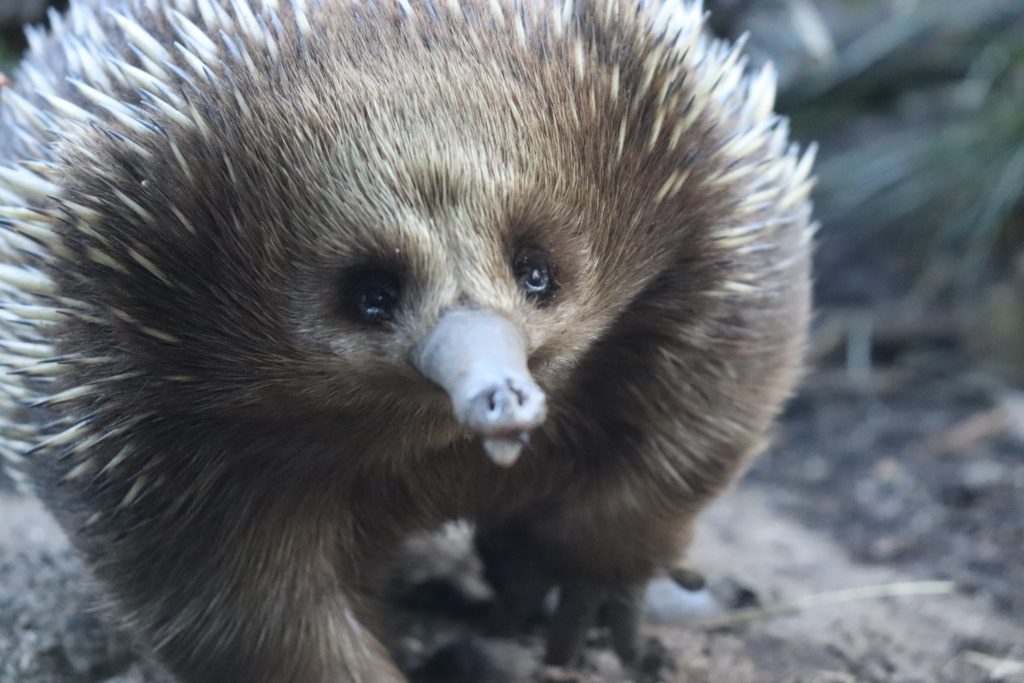
Well, talk to the hedgehog.  Few of earth’s creatures can travel with the whimsy of a hedgehog. Do they free fall from trees on purpose? You bet—because it’s quicker than climbing down. When they fall from a tree do they make a sound? We have no idea (that’s in another study), but scientists around the water cooler mentioned a giggle.

hedgehog_pic

And why not? They have quills to buffer the fall and allow them to tumble and spring up good as new. Researchers and scientists are taking a closer look in the hope of saving our athletes in the NFL and Tour de France and Durango High School (home to our teenage daughters and sons— Go Demons!) from sometimes fatal concussions or eventual brain damage. Our helmets today are hard and unforgiving, and often hurt athletes as much as the actual fall.

Innovator, Hedgemen, has researched the hedgehogs quill technology and buffering system, resulting in a new line of helmets inspired by the hedgehog. Keep it in mind when you shop for helmets in the near future. Buildings too are following the lead of the hedgehog, pushing innovations in architectural design that radically reduce energy consumption.

hedge_hog_building

Now take a look at the Shinkansen Bullet train. The bullet, as people like to call it, travels 200 miles per hour. It’s very James Bond and if 007 were on such a train he would be able to have shaken martini in style without any disturbing background noise or motion. Even in a cartoon, the word inside the bubble would be ‘Whoosh.’

In reality, the sound this train produced was more like a thunder clap that burst all bubbles and rattled teeth within a mile radius.

Fortunately, Eji Nakatsu, the Shinkasen’s 500’s Chief Engineer, happened to be an avid bird watcher and had the instinct to look around nature (i.e. Biomimicry) and find a model of something that could move smoothly and quietly between two mediums.

He knew the answer could not be human-made–we had taken our technology as far as it or we could go. He discovered the answer in the Kingfisher, a bird who dives from the air into bodies of water without much splash.

Modeling the train front after the bird’s beak resulted in a quieter train with the added bonus of efficiently producing 15 percent less energy.

Speaking of less energy, have you ever noticed how most large animals conserve their energy and only use it when they really need it? There is something to be learned from that observation too.

The truth is, ‘There’s no place like home,” and Biomimicry sees the genius answers are right here (and we don’t have to be good looking to see them).

King_fisher_biomimicry

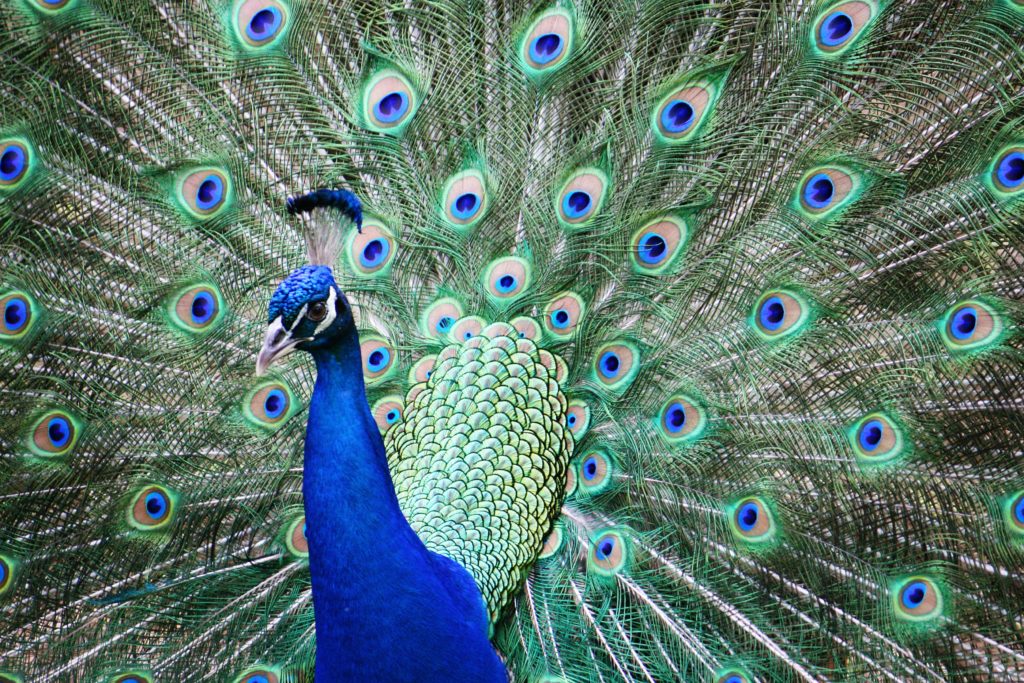
Next up: the peacock. We call it the “Peacock Principle”.  Peacocks are a brilliant symphony of blue and gold in all their shades and variations. It’s a flamboyance of color matched only—albeit, not as nuanced—by Elton John. Actually, the Peacock is brown. I know. This fact is world-rocking, in and of itself—especially to the Peacock. We are wedded to the Peacock and its beauty, and use chemicals and pigments to recreate its likeness in our fabrics and jewelry and jewelry boxes. The brown Peacock would burn and die if its colors were invented by toxins, so instead of imitating the look, we are learning to emulate the process.

It’s a more curious and patient vision we are acquiring for the living world we belong to. What we see now is that the beautiful colors of a Peacock are created with structural color and transparent layers. When light reflects to us through these layers it creates the color blue, or green or gold to our eyes. Beauty is in the eye of the beholder.

So, what if we could make our fabrics with the same principles of color that a Peacock has innovated? What if we didn’t have to use toxic dyes to make gorgeous color for our jewelry? Biomimicry takes us to the edge and we simply must jump in and innovate following natures amazing design principles.

The E-reader display screen uses the Peacock Principle. Developed by Qualcom, the screen needs no back lighting, because it uses layers and the ambient light to create the different color to your eye; in so doing, this folding in of nature and technology, is a far less aggressive approach and uses a much lower energy.

See more examples of Biomimicry at work by following our Face Book page.

Peacock_Pic

What does biomimicry have to do with branding?

While Biomimicry places nature at the heart of design, branding creates the meaning behind the design and why it matters. The best brands today inspire us to become something; to be part of something; to reach for possibility. We find our sense of belonging; our tribe; when we don a Nike t-shirt and “Just do it,” or open up our Apple lap-top with the inspiration to defy the rules and create the world we want; to clean house, knowing “Seven Generations” will benefit from our non-toxic sprays.

We are optimists, remember? Life is always in search of life. No matter how big our egos grow, the planet will evolve either with us or without us. Biomimicry is a platform for creating products and brands with nature as the Designer. We create and exchange goods, and we belong again to the nature of things. We act as if nature matters—and in the end it does, for life’s sake. It’s a new business and economic paradigm calling. It’s our path to a livable world. It’s time to pivot.

By Claire Attkisson (she’s the sustainability/marketing geek) and Elizabeth Arlen (she’s the writer/editor and the funny one.)

______________________________

If you liked this and want more, join us by subscribing to our weekly eNews Get Real— an Innovation for Good mash up of marketing and lifestyle tips and positive news about cool sustainable brands and innovators changing business for good. Get Real inspires and offers practical pro-tips to help individuals and businesses increase their positive impact.

Live Creative Studio is a sustainable business, marketing, and shopping hub. Live Creative offers strategic creative for purpose brands; strategic sustainability for any business; and a curated sustainable marketplace for everyone to shop their values every day.

Live_creative_studio_logo_design_purpose_brand_agency

Filed Under: Blog, Innovation Tagged With: Biomimicry, durango marketing agency, Durango sustainable business, purpose brands, purpose-driven marketing, sustainable design, sustainable innovation

The Sustainable Business Path—From “Do Good” to Competitive Advantage

September 13, 2021 By Elizabeth Arlen

bite-logo

Marketing Sustainability

What’s in a word? Everything. It holds memories, smells, assumptions, beliefs, colors, positions, ideas, right and wrong. A word is loaded; a single word can communicate entire worlds. What does the word ‘Sustainability’ communicate? What kind of world does it hold out as possible? To my mind, even ‘Photosynthesis’ sounds sexier. Who wants to sustain? Stay the same? Who wants to be regulated and or told how to live and what to believe, as if the word Sustainability holds the truth? Who wants a business that does great things for the planet, but fails financially, as is the reputation for good causes (and if they are unsound, it’s true, because that’s business law).

As for colors and smells, I conjure up splashes of mulch, recycling, and, patchouli. When passionate people talk about sustainability I smile with a glazed expression and actually have ‘left the premises’. As an outsider, I do not trust good causes and their ability to actually bring about change. So many come from the clouds and return there because they have no traction in the real world. It’s the old spinach metaphor: if it’s good for you, it tastes bad; if it’s about a good cause, especially saving the planet, it’s a green dream that asks business to shrink down to trade negotiations at the front flap of a yurt.

Yet here I am, actively standing in a hub of ‘Sustainability’ and ‘Sustainable Business’ in the tiny rural mountain town of Durango, Co, by co-creating/editing the ‘Live Creative Studio’ blog each month. Live Creative was founded by Claire Attkisson whose manifesto is “just start”—just start reading and educating yourself about sustainable innovation; just start talking about Sustainability.

Wait, let’s get back to this blog–and words. Sustainability has a word and image problem ; it doesn’t communicate possibility or innovation or creativity or design or infinity. For a world that craves excellence, this is a hard word to get behind. What does innovation in sustainability even look like? The more I “just start”, the more I use words like innovation, creativity, and return on investment to describe what’s possible within the world of Sustainable Business.

Yet, these hopeful words are not usually associated with sustainability for most of us on this blue green plant. To help solve this communication problem, some people have moved on to words like: ‘Green Economy’ (but that leaves out all of us great people) or ‘Living Economy’ (what?) or the ‘New’ or ‘Next Economy’ (maybe?) or the ‘Regenerative Economy’ (that’s more inspiring for sure!)

What is a Sustainable Business?

Simply put, my new understanding of Sustainable Business is this:

An organization of people who view the purpose of business as a driver and creator of prosperity for people, the planet, and the economy.

This definition reflects the “triple bottom” line backbone of sustainable business. A business cannot do good if it is no longer in business. And notice, this definition is not prescriptive; there is no sustainable business manual. However, there are sustainable business frameworks that help us expand our thinking and give us a structure to make decisions, such as: Biomimicry, The Natural Step, Cradle to Cradle, and more.

This is where language comes in again. These sustainability frameworks give us the conceptual tools to imagine new possibilities for business and new ways of thinking about manufacturing and a product’s end of life. Language allows us to communicate these concepts and begin to prototype them in the business world. In other words: We can’t evolve as a species with the same thinking that got us to where we are now (I paraphrase Einstein here). Sustainability points to a vision. It is not THE vision. We have had many visions in our evolution. That is why we have cars, computers, and yes, the sweater vest. We started out nomadic and that urge has funneled to our minds, where our imaginations and intelligence do the traveling.

In just a few months of blog writing about sustainability, I’m struck by these facts: Sustainable Business is not small and cute and just the luxury of people who can afford to spend $200 on a basket of organic food from a beautiful food salon (I love good healthy food, but how can we scale this for the masses?); it isn’t about hemp and bamboo sheets (although those are awesome, please keep making them!).

Sustainability isn’t exclusive and it isn’t about killing big business and taking the fun out of life in order to save it. In fact, what I’m learning is that businesses that don’t tackle sustainability (people, planet, profit) will be left behind by consumers (people) who will find a like business that does!

The more I “just read” or “just talk” about sustainable business the more I realize how powerful global commerce is to scaling change for the better.   For example, have you heard of the “Cradle to Cradle” sustainable design framework? (I like this sustainability framework, as it gives us a visual that is key to our survival: the circle.) Cradle to Cradle follows nature’s principles of abundance and circular nutrient flows. If your eyes are glazing over, stop now and watch this short and fun video on Cradle to Cradle.

Live Creative Studio is working with Durango, Colorado based Zia Taqueria to help them move toward sustainable food to-go packaging. One of the companies being vetted is Be Green Packaging, which used the Cradle to Cradle Design Certification process to create food packaging products that are tree free, 100% compostable, and their manufacturing process recycles water, reuses general waste and scraps, and it’s “end of life” is a nutrient for the earth that generates healthy, fertile soil.

Cradle to Cradle Certified To Go Packaging by Be Green Packaging

Circular or closed loop product design and manufacturing, such as this, has helped to evolve the language of sustainability into a global concept called the “Circular Economy”. Talk about the power of language and businesses role in scaling sustainability.

Marketing and Scaling Sustainability

Scaling sustainability is essential to solving our global crisis of poverty, environmental catastrophe, and a quickly changing climate that won’t be fit for life. It is critical for businesses of all sizes and shapes—from the small to global corporate giants—to embrace a sustainability framework (think: Cradle to Cradle, The Natural Step, or BCorp to name a few) and put their own stamp on the triple bottom line business model and start innovating around plastics, toxic product ingredients, air and water pollution, energy, waste, water, gender equity, and diversity and inclusion, to name a few.

If every business on the planet “just started” on the path of sustainability and inspired their employees through a shared purpose, the world would indeed be reborn in alignment with the operating principles that sustain life.

Marketing for Sustainable or Purpose Brands Requires Transparency and Accountability

Each company’s sustainability program will look different. Some companies start with a goal of zero waste, others the goal of 100% renewable energy, and still more, take a deep dive into sustainable packaging or diversity and inclusion and gender equity. For Example:

Starbucks: “Our aspiration is to become resource positive — storing more carbon than we emit, eliminating waste; and providing more clean, fresh water than we use.” Starbucks tested one of their strategies to get people to use reusable cups in the UK in 2018, and found that charging a 5-pence disposable cup fee — along with a 25-pence reusable cup incentive — pushed the rate of hot drinks served in reusable cups up from 2.2 percent to 5.8 percent. Starbucks has a long way to go to shrink its environmental footprint. The company’s yearly greenhouse gas emissions are roughly equivalent to the pollution from almost 14 coal-fired power plants — nearly on par with other giant corporations like Microsoft. Its annual waste adds up to more than two times the weight of the Empire State Building, and the water it uses could fill 400,000 Olympic-sized swimming pools. Setting ambitious goal is key to sustainability, but so is accountability.

Starbucks

Amazon: Amazon CEO Jeff Bezos says Amazon is committed to meet the goals of the Paris climate agreement 10 years early. As part of the plan, Amazon has agreed to purchase 100,000 electric delivery vans from vehicle manufacturer Rivian Bezos expects 80% of Amazon’s energy use to come from renewable sources by 2024, before transitioning to zero emissions by 2030.

Svenskt Stål AB (Swedish Steel or SSAB), the Nordic steel giant’s sustainability goal is to use renewable hydrogen to produce fossil-free steel by 2026. Momentum is growing towards the decarbonization of one of the world’s most energy intensive industries. This is 10 years ahead of schedule. How have they done this? Sustainable thinking and innovation.

H&M has an entire ‘Conscious collection’ made from pineapple skins and orange rinds, plus a garment recycling program, allowing anyone to recycle any brand at their H&M stores.. And, they just hired their female sustainability director to run the entire company. The fashion industry weighs heavy on natural resources, which is one reason H&M Group has set up clear goals going ahead: “our mission is to only use recycled or other sustainably sourced materials by 2030.”

The Promise of the Sustainable or Purpose-Driven Business Path

One of the most exciting elements of sustainability is that it isn’t political (or it shouldn’t be). It’s not just for the “greens” to take up but  for all businesses to profit while doing good for people and the planet. What a global foce that would be. When we see business as it is—at the center of scalable global sustainability, we will see a huge shift.

For example, what if we designed commerce for health as well as profit? Or designed toxic chemicals and pollution out of everyday products and manufacturing systems? What if we designed for clean water? What if we designed for equality? When we look at design in this way we begin to see that regulation is a “signal of poor design” (Think: William McDonough). What if we designed global commerce in such a way that it no longer required government regulation (just confirmation of health and wellness)?

Green chemistry is key to the creation of new
non-toxic materials

This sounds lofty and it is, but so was the goal of going to the moon and we did that over 50 years ago (and our lives didn’t even depend on it!). We can do this. We must do this. Both survival and innovation are in our DNA. We  are our own heroes, remember? New thinking and imagining is our path to get there.

The “truth” that sustainability is really pointing to is the transformation of our global economy. An economy based on reality (not a false illusion)—that our Earth’s resources are finite and that there is no such thing as “away” as in “throw that away” (burning garbage causes air, land, and water pollution and landfills are a terrible time capsule for humanity to leave behind for the future to uncover).  

Nature is the model we can turn to now. Nature has survived for billions of years through both competition AND collaboration, resulting in incredible diversity and abundance, even within a finite system.

This discovery —that the world is finite, yet nature still thrives, is akin to discovering that humans are not the center of the universe or that the world is not flat, but round.

So, you see, sustainability is our new evolutionary “tool” or “technology”.  It starts with language, talking, sharing, doing, and coming together and imagining a new world. Every great invention or revolution came from creating a conversation, a common language that evolves, just like the notion of Democracy or Equality or Feminism or Humanity.

“Just Start: One step on the sustainability path at a time”

Durango’s Sustainable Business Hub

So that’s what we’re doing. Live Creative Studio is creating a sustainable business hub in a tiny rural mountain town (Durango, Colorado) where businesses of all shapes and sizes can “just start” on the sustainability path by sharing and helping each other and therein becoming more inspired by possibilities and the return on their investment.  There are already 20+ businesses in our community on the sustainability path.  How many are in your community? Find them and support them. Create one. Join us and prove to the world that business is a powerful force for good. Talk about a force of nature.  

Check out our video!

__________

Live Creative Stacked Logo

Live Creative is a sustainable business, marketing, and shopping hub. Our Creative Studio offers authentic marketing, branding, and sustainable business expertise to ethical, sustainable, and purpose brands. And Sustainable Business Team offers sustainability strategy and goals setting as well as sustainable packaging services. And, our Lifestyle Team curates our global Sustainable Marketplace, the Durango Sustainable Biz Guide, and Get Real—our inspiring Innovation for Good weekly newsletter. Follow us on Insta: @livecreativestudios, like us on Facebook: Live Creative Studio and join our FB Group: Sustainable Business Idea Exchange.

Filed Under: Blog, Innovation, Marketing Biz Tips Tagged With: Durango sustainable business, green chemistry, sustainability frameworks, sustainable business, sustainable innovation, sustainable marketing, sustainable product design, sustainable products

« Previous Page
Next Page »

Subscribe to our "Get Real" weekly eNews and get inspiring sustainability tips and ideas, and learn about the creatives, entrepreneurs, and brands who are innovating a new way of designing and doing business that benefits people and the planet. 

Thank you for subscribing!

Your privacy means everything to us. We promise not to sell or share your email address!

LiveCSFINAL-Stacked-in-White

Get In Touch!

970. 903.3241

1259 Main Ave.
Durango, CO
81301

claire@livecreativestudio.com

Let's Connect

la-plata-impact-fund-logo
durango-sustainable-business-guide-logo

Copyright © 2026 Live Creative Studio. All Rights Reserved.